Can peptides help with menopause symptoms? An honest overview
The short answer
For the symptoms that define menopause, hot flashes, night sweats, vaginal dryness, and bone loss, the treatments with real evidence and FDA approval are menopausal hormone therapy (HRT) and, where weight is the concern, the branded GLP-1 medicines. The "peptides" marketed to women in midlife are a different and weaker story: the copper peptide GHK-Cu is studied as a skincare ingredient, the research peptides MOTS-C and DSIP rest mostly on animal and early studies with no menopause trials, sermorelin is no longer a currently-approved product, and the one approved peptide medicine with a related use is approved only for premenopausal women. So peptides are, at best, a gentle and largely unproven secondary consideration, not the answer to menopausal symptoms.
If you have spent any time in midlife-wellness feeds, you have probably seen peptides pitched as a gentler, more natural fix for the hot flashes, poor sleep, stubborn weight, and low energy that arrive with menopause. It is a genuinely appealing idea, and it is worth answering plainly. For the symptoms that actually define the menopausal transition, the treatments with real evidence and FDA approval are hormone therapy and, where weight is the main concern, the branded GLP-1 medicines. The compounds sold under the “peptide” banner are a much weaker proposition for menopause: some are cosmetic, some rest almost entirely on animal studies, one is no longer a currently-approved product, and the single approved peptide medicine with a related use is approved only for premenopausal women. This guide walks through what menopause symptoms are, what genuinely helps them, and exactly where peptides do and do not fit, so you can bring an honest picture to a provider rather than a marketing promise.
What are the symptoms peptides are marketed to fix?
The menopausal transition is not one symptom but a cluster, and knowing the cluster is the first step to judging any therapy against it. The hallmark symptoms are vasomotor symptoms, hot flashes and night sweats, which affect a large majority of women and are far from brief: in the SWAN cohort, the median total duration of frequent vasomotor symptoms was 7.4 years, and longer still for some groups (Avis et al., Duration of Menopausal Vasomotor Symptoms, SWAN, JAMA Intern Med 2015). Alongside those come genitourinary symptoms such as vaginal dryness, sleep disruption, mood changes, accelerated bone loss, and a shift in body composition toward more abdominal fat and less lean mass.
That list matters because it is the yardstick. A therapy that “helps menopause” should move at least one of those needles in menopausal women, with evidence to show it. As you will see, hormone therapy clears that bar for several of them, the branded GLP-1 medicines clear it for weight, and the marketed peptides largely do not clear it at all. If weight change specifically is your main concern, our companion guide on GLP-1 medication for menopause-related weight gain goes deeper on that single question.
What actually helps menopause symptoms?
For the core symptoms of menopause, the evidence-backed options approved by the FDA are hormone therapy and, for weight, the branded GLP-1 medicines, and it is worth putting those first before any discussion of peptides. Menopausal hormone therapy is estrogen, taken alone or, for women who still have a uterus, combined with a progestogen. A representative estradiol label lists among its FDA-approved indications the “Treatment of moderate to severe vasomotor symptoms associated with the menopause,” the “Treatment of moderate to severe symptoms of vulvar and vaginal atrophy associated with the menopause,” and the “Prevention of osteoporosis” (Estradiol tablet label, DailyMed). Those indications map almost exactly onto the symptom cluster above.
The guidelines are direct about how well it works. The Menopause Society (formerly the North American Menopause Society) states in its 2022 position statement that “Hormone therapy remains the most effective treatment for vasomotor symptoms (VMS) and the genitourinary syndrome of menopause and has been shown to prevent bone loss and fracture” (The 2022 Hormone Therapy Position Statement, Menopause 2022;29(7):767-794). ACOG likewise describes systemic estrogen therapy as the most effective treatment for menopause-related vasomotor symptoms, and, tellingly, holds that the evidence does not support testosterone, compounded bioidentical hormones, phytoestrogens, or herbal supplements for those symptoms (ACOG clinical guidance on menopausal symptoms, via AAFP). The same bodies that endorse hormone therapy specifically decline to endorse the unproven alternatives it is often measured against.
Hormone therapy is not risk-free, and honesty requires saying so. The estradiol label carries boxed warnings, opening with “ESTROGENS INCREASE THE RISK OF ENDOMETRIAL CANCER”, the reason a progestogen is added for women with a uterus, along with warnings about cardiovascular events, stroke, blood clots, and probable dementia in older women (Estradiol label, DailyMed). The Menopause Society frames the trade-off by timing: “For women aged younger than 60 years or who are within 10 years of menopause onset and have no contraindications, the benefit-risk ratio is favorable for treatment of bothersome VMS and prevention of bone loss” (2022 Position Statement). That is a therapy with real, quantified benefits and real, quantified risks a provider weighs against your history, a fundamentally different situation from a compound with no menopause evidence at all. For a direct side-by-side, see our comparison of peptides vs HRT for menopause.
For weight specifically, the branded GLP-1 medicines are the other genuinely approved option. Semaglutide (sold as Wegovy) and tirzepatide (sold as Zepbound) are approved by the FDA for chronic weight management and are prescription medicines, not gray-market research chemicals. We cover the nuance, including that dedicated menopause data is still limited, in the GLP-1 for menopause weight gain guide and in peptides and metabolic care for women in 2026.
Are any peptides approved by the FDA for menopause?
No peptide is approved by the FDA to treat menopause, and the ones marketed to midlife women are not even a single category of thing. It helps to take the most common ones one at a time, because each has a different, and mostly disappointing, relationship to menopausal symptoms.
GHK-Cu, the copper peptide, is a naturally occurring copper-binding tripeptide found in human plasma and studied for roles in collagen synthesis and skin remodeling (Pickart & Margolina, Int J Mol Sci 2018). Most of what people meet in midlife is a topical form, the kind of thing in an over-the-counter serum, and its evidence is about skin: it is a skincare ingredient with cosmetic-side evidence, not a therapy for hot flashes, bone loss, sleep, or any core menopausal symptom. If skin and collagen through midlife are on your mind, that is the honest lane for GHK-Cu, and nothing more.
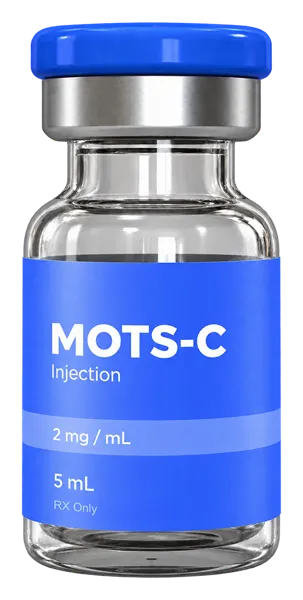
MOTS-C and DSIP are the “research peptides” most often floated for menopausal energy, metabolism, and sleep. MOTS-C is a mitochondria-derived peptide, and its metabolic effects, improved insulin sensitivity, reduced fat accumulation, come almost entirely from mouse studies; in one high-fat-diet model, “MOTS-c prevented diet-induced obesity and insulin resistance” (Kim et al., MOTS-c: A novel mitochondrial-derived peptide, PMC 2016). That is genuinely interesting preclinical biology, but it is animal data, not evidence in menopausal women, and it should never be read as proof of a human menopause benefit. DSIP (delta sleep-inducing peptide) is marketed for sleep on an even thinner evidence base, again without menopause-specific human trials; our companion guide to peptides for sleep during menopause covers what genuinely helps midlife sleep. Neither has been tested in a trial of menopausal women, so any benefit for hot flashes, bone, or menopausal sleep is an extrapolation rather than a finding.
Sermorelin is a growth-hormone-releasing peptide sometimes pitched to women for body composition and energy. It is important to be precise here: sermorelin was once FDA-approved (as Geref), but that approval was withdrawn in 2009, so it is not a currently-approved product today. Presenting sermorelin as an “FDA-approved” menopause option would be inaccurate, and it has no menopause-specific efficacy data to stand on regardless; our full explainer on sermorelin for women walks through the Geref history and the thin adult evidence.
Bremelanotide (PT-141), sold as Vyleesi, is the one genuinely approved product that touches this conversation, and its approval is narrow enough to rule out the menopausal use most readers have in mind. The Vyleesi label indicates it “for the treatment of premenopausal women with acquired, generalized hypoactive sexual desire disorder (HSDD),” and states plainly that it is “not indicated for the treatment of HSDD in postmenopausal women or in men” (Vyleesi label, DailyMed). Its label also concedes that “The mechanism by which VYLEESI improves HSDD in women is unknown.” In other words, even the approved peptide here is, by its own labeling, off-limits for the postmenopausal women it is most often marketed to; we cover its real, on-label use in PT-141 for women.
Is the evidence for peptides in menopause any good?
The honest summary is that the menopause-specific evidence for peptides ranges from cosmetic to preclinical to essentially absent, which is a different universe from the guideline-endorsed data behind hormone therapy. GHK-Cu’s evidence is about skin appearance, not menopausal symptoms. MOTS-C rests on animal models. DSIP has no meaningful menopause trials. None of these has the kind of randomized human data in menopausal women that would let a provider quote a benefit with any confidence, which is exactly why the major menopause societies do not list peptides among effective treatments.
Even the GLP-1 medicines, which are frequently lumped in with “peptides” but are actually an approved prescription class of their own, come with an evidence caveat when the question is narrowed to menopause. A 2026 review in Cureus concluded that there are no long-term studies of these medications specifically in menopause, that most trials ran only three to six months, and that menopausal women remain underrepresented in clinical research, with much of the data coming from post-hoc analyses of general obesity trials rather than menopause-designed studies (Graczyk & Bisschops, Cureus 2026). If even an approved, well-studied class has thin menopause-specific data, the unstudied research peptides are on far shakier ground. The reasonable conclusion is not that peptides are proven to fail menopause, but that they are unproven for it, and “unproven” is not the same as “gentle and safe.”
What are women saying about MOTS-C and DSIP online?
Online talk about these two peptides is enthusiastic, mixed, and almost entirely anecdotal, which is worth knowing before a feed convinces you otherwise. In a July 2026 sample of 19 posts on X about MOTS-c, users most often described it as an energy and mitochondrial peptide, debated how to stack it with SS-31, and folded it into wider routines with NAD+, GHK-Cu, GLP peptides, fasting, and cardio; others dismissed the trend as a hype cycle, and one user who expected to criticize it said he revised his view after a month of daily use. For DSIP, a smaller July 2026 sample of 9 X posts included women trying it for midlife night waking: one reported it helped her get back to sleep during the first week but later left her groggy and unrested, and another commenter called it something “most people get nothing from.” These are self-reports, not trial outcomes, and none of them measured hot flashes, bone density, or any other core menopause symptom.
So can peptides help with menopause symptoms?
The fair, evidence-based answer is that peptides are, at most, a gentle and largely unproven secondary consideration, not the treatment for menopausal symptoms. GHK-Cu has a legitimate but narrow role as a topical skincare ingredient. The research peptides like MOTS-C and DSIP have interesting preclinical biology and plenty of online enthusiasm, but no human menopause evidence yet. Sermorelin is not a currently-approved product. And the one approved peptide medicine, Vyleesi, is approved only for premenopausal women. Set against that, hormone therapy has decades of trials and unambiguous guideline endorsement for the core symptoms, and the branded GLP-1 medicines have real approval for weight. If you came looking for a peptide that quiets hot flashes or protects your bones, the honest news is that the substantive options are the approved therapies, with peptides a peripheral and mostly cosmetic footnote.
None of this is a decision to make from an article. Whether hormone therapy fits you depends on your symptom pattern, your personal and family history, including any history of breast cancer, blood clots, or cardiovascular disease, and how far you are past your final period, and a licensed provider weighs all of that on a real visit before recommending anything. A responsible provider never commits to a specific prescription before seeing you, and no prescription is promised in advance. Peptides are not a shortcut around that evaluation; the better use of your energy is a proper conversation about the options that actually have evidence behind them.
Status: MOTS-C: Not FDA-approved; sold by some telehealth providers as a compounded prescription. An FDA advisory committee reportedly voted in July 2026 to recommend allowing pharmacies to compound it; nothing has changed yet. DSIP: Not FDA-approved for any use. What these status terms mean.
Sources
Every clinical figure on this page traces to a menopause guideline, an FDA drug label, or the peer-reviewed literature, listed here so you can verify each claim directly.
- The 2022 Hormone Therapy Position Statement of The North American Menopause Society, Menopause 2022;29(7):767-794 (PubMed), the statements that hormone therapy is the most effective treatment for vasomotor symptoms and the genitourinary syndrome of menopause and prevents bone loss/fracture, and that the benefit-risk ratio is favorable for women under 60 or within 10 years of menopause onset.
- The 2022 Hormone Therapy Position Statement (full text, Menopause), the full position statement behind those conclusions.
- Estradiol tablet Prescribing Information (DailyMed), the menopausal indications approved by the FDA (moderate-to-severe vasomotor symptoms, vulvar and vaginal atrophy, prevention of osteoporosis) and the boxed warnings, including the endometrial-cancer warning.
- ACOG clinical guidance on management of menopausal symptoms (summary via AAFP), ACOG’s position that systemic estrogen therapy is the most effective treatment for menopause-related vasomotor symptoms and that the evidence does not support testosterone, compounded bioidentical hormones, phytoestrogens, or herbal supplements for those symptoms.
- Avis NE, et al. Duration of Menopausal Vasomotor Symptoms Over the Menopause Transition (SWAN), JAMA Internal Medicine 2015 (PMC), the median total duration of frequent vasomotor symptoms of 7.4 years, establishing that menopausal symptoms are typically prolonged rather than brief.
- Vyleesi (bremelanotide) Prescribing Information (DailyMed), the indication limited to premenopausal women with acquired, generalized HSDD, the limitation of use excluding postmenopausal women and men, and the statement that its mechanism in HSDD is unknown.
- Pickart L, Margolina A. Regenerative and Protective Actions of the GHK-Cu Peptide, International Journal of Molecular Sciences 2018 (PMC), GHK-Cu as a naturally occurring copper-binding tripeptide studied for collagen synthesis and skin remodeling (a cosmetic/topical context).
- Lee C, Kim KH, Cohen P. MOTS-c: A novel mitochondrial-derived peptide regulating muscle and fat metabolism, Free Radical Biology and Medicine 2016 (PMC), the metabolic effects of MOTS-c (prevention of diet-induced obesity and insulin resistance) demonstrated in mouse models, i.e., preclinical animal data rather than human menopause evidence.
- Graczyk NA, Bisschops J. GLP-1 Receptor Agonists (GLP-1RAs) for Obesity and Symptoms in Menopause: A Review, Cureus 2026 (PMC), the limited, short-duration, and post-hoc nature of GLP-1 evidence specific to menopausal women.
Educational information only, not medical advice. Clinical statements are sourced to the FDA drug labels, the Menopause Society and ACOG guidance, and the peer-reviewed literature linked above. Community summaries describe self-reported posts, not evidence of effect. Last reviewed October 12, 2026.
Advertising disclosure: links marked "Paid link" go to Bodybuilding Peptides (trybbpeptides.com), an affiliate destination, and The Midlife Protocol may earn a commission if you buy there. Our coverage is independent of that relationship, and nothing on this page is medical or legal advice.
 See it at Bodybuilding Peptides