Oral minoxidil for women: what the studies in women show, and the facial hair trade-off

The short answer
Low-dose oral minoxidil is an old blood-pressure pill that dermatologists prescribe off-label for female pattern hair loss. Small randomized trials in women found it worked about as well as topical minoxidil. The most common side effect is unwanted facial and body hair, reported by about half of women in some studies; serious heart effects are rare.
Scroll a midlife women’s health feed for long enough and oral minoxidil turns up: a small daily pill, prescribed off-label, pitched as an easier alternative to the scalp foam. It is a real treatment with real studies behind it, but the studies in women are small, and the side effect women talk about most, extra hair on the face and body, is common rather than rare. This page sets out what the research in women actually measured, what women report living with, and how a hair-loss pill fits next to the bigger menopause conversation.
What is oral minoxidil, and why are women taking it for hair loss?
Oral minoxidil is a decades-old blood-pressure tablet that is now prescribed in much smaller amounts, off-label, for hair loss. Its approved label is narrow: the tablets are “indicated only in the treatment of hypertension” that has not responded to a diuretic plus two other blood-pressure drugs (minoxidil tablets label, DailyMed). Hair growth was first noticed as a side effect of those full doses, which is why the hair-loss use is called low-dose oral minoxidil, often shortened to LDOM.
The reason women in particular are interested is that female pattern hair loss is common and the approved options are few. A 2026 review in the American Journal of Clinical Dermatology estimates that androgenetic alopecia affects nearly 50% of women during their lifetime, notes that topical minoxidil is the only FDA-approved treatment for it in women, and lists oral minoxidil among the off-label options (Kearney et al., Am J Clin Dermatol 2026). The topical version also asks a lot: a 2023 review notes that women stop it early because of scalp reactions such as itching or redness, or because daily use changes hair texture and makes styling harder, which is where a pill starts to sound appealing (Ramos et al., An Bras Dermatol 2023).
What do the studies in women actually show?
The evidence in women is real but thin: a handful of small randomized trials and several larger studies that look back at clinic records. A 2025 expert consensus describes the support as coming from small studies and notes that larger trials are lacking (Akiska et al., JAMA Dermatol 2025). In plain terms, that is “small human trials plus observational data,” a step below the evidence behind an approved, labeled use.
The trials that randomized women found oral minoxidil performed about as well as topical minoxidil, not clearly better:
- 1 mg oral vs 5% topical (52 women). An open-label randomized trial in Brazilian women with female pattern hair loss found both groups improved in hair density and photos, with no significant difference between them, though the authors describe a trend favoring the pill (Ramos et al., J Am Acad Dermatol 2020, as summarized in Ramos et al., An Bras Dermatol 2023).
- 0.25 mg oral vs 2% topical (72 women, 9 months). In a triple-blind trial, average hair density rose from 102 to 115 hairs per cm² on the pill and from 107 to 113 on the topical, and the difference between groups was not statistically significant (Vahabi-Amlashi et al., Dermatol Ther 2021).
- 0.25 mg vs 1 mg oral (30 women). A double-blind trial found the 1 mg amount outperformed 0.25 mg, which suggests the effect tracks with dose (Nascimento e Silva et al., J Am Acad Dermatol 2022, as summarized in the 2023 review).
Pooling the trials points the same way. A 2025 meta-analysis of four randomized trials in androgenetic alopecia with 279 patients found no difference between oral and topical minoxidil in hair density or hair diameter, but found hypertrichosis (extra body hair) about twice as often on the pill (Sobral et al., Int J Dermatol 2025).
Two more details matter for women. Response is not universal: in a 41-patient study, 6 of 15 women (40%) improved after six months compared with 19 of 26 men (73%) (Jimenez-Cauhe et al., J Cosmet Dermatol 2024). And the 2023 review notes there are no published series of women using more than 2 mg a day, which is why everything here applies to the low amounts used in studies (Ramos et al., 2023). None of the trials was designed around menopause.
What side effects do women report on oral minoxidil?
Unwanted hair on the face and body is the side effect women report most, and in women-only data it is common. Fluid retention, dizziness, headache and a temporary shed come next, and serious heart problems are rare at hair-loss doses.
| Study | Who | Extra facial or body hair | Other effects reported |
|---|---|---|---|
| Vañó-Galván et al., 2021 | 1,404 patients, 943 of them women | 15.1% overall | Lightheadedness 1.7%, fluid retention 1.3%, fast heart rate 0.9%; 1.7% stopped because of side effects |
| Sanabria et al., 2021 (via 2023 review) | 215 women in a 435-patient study | 54% of women | Headache 10%, lower-leg swelling 9%, dizziness 7%, insomnia 7%, palpitations 4%; 44% had a temporary shed |
| Sharma et al., 2026 | 102 women surveyed | 71.6%, mostly mild or moderate | 93.2% of those with extra hair did not see it as a reason to stop |
| Dewey et al., 2026 | 432 women also taking spironolactone | 12.3% | Dizziness or lightheadedness 12.0%; any side effect 37.7% |
The spread in those numbers is partly about how each study asked: a phone survey that asks directly about unwanted hair picks up more than a chart review does. A 2025 review of LDOM side effects puts hypertrichosis at around 15% across studies, more often in women and at higher doses, and fluid retention at 1.3% to 10%, again more often in women and usually within the first one to three months (Jimenez-Cauhe et al., J Clin Med 2025).
Does oral minoxidil cause hair growth everywhere?
It can cause extra hair beyond the scalp, most often on the face, arms and legs, and it fades after stopping. The tablet label, written for much higher blood-pressure doses, says the hair “is usually first noticed on the temples, between the eyebrows, between the hairline and the eyebrows, or in the side-burn area,” that it was seen in about 80% of patients at those doses, and that after stopping, “1 to 6 months may be required for restoration to pretreatment appearance” (minoxidil tablets label, DailyMed). In the women’s survey above, the face, arms and legs were the most common sites (Sharma et al., 2026). In a small study of women with chronic shedding, 13 of 36 developed facial hair; six needed nothing, four waxed and three used laser hair removal (Perera and Sinclair, F1000Research 2017).
Does oral minoxidil cause weight gain?
The weight change described on the drug’s own label is fluid, not fat. The tablet’s patient information says “a smaller weight gain (2 to 3 pounds) often occurs” when treatment starts, and treats a quick gain of five pounds or more, or swelling in the face, hands, ankles or stomach, as a possible sign of fluid retention to report to a doctor (minoxidil tablets label, DailyMed). At hair-loss doses, fluid retention affected 1.3% in the large cohort and 9% of women reported lower-leg swelling in the 435-patient study, so it is worth watching for, especially in the first few months.
Is oral minoxidil safe for women?
In the published hair-loss studies, low-dose oral minoxidil was well tolerated by most women, but it is a prescription blood-pressure drug with real cautions. The largest cohort reported no life-threatening side effects among 1,404 patients (Vañó-Galván et al., 2021), while an analysis of the FDA’s adverse event reports found a signal for pericardial effusion (fluid around the heart) even at 1.25 mg or less, a correlation the authors say does not prove cause (Gupta et al., J Cosmet Dermatol 2025). The 2025 side-effect review notes that severe events such as pericardial effusion were extremely rare and often linked to compounding errors that produced an excessive dose (Jimenez-Cauhe et al., 2025).
Who should be cautious is better defined than the benefits:
- Pregnancy and breastfeeding. The label says safe use in pregnancy “has not been established” and that minoxidil “should not be administered to a nursing woman” (DailyMed). A 2026 review lists pregnancy, pericardial disease and uncontrolled high blood pressure as contraindications (Ong et al., Am J Clin Dermatol 2026).
- Other blood-pressure medicines. In the 432-woman cohort, taking at least one other blood-pressure-altering drug roughly tripled the odds of dizziness or lightheadedness on standing (odds ratio 3.29) (Dewey et al., 2026), a relevant point for anyone already on a blood-pressure medicine.
- Heart or kidney conditions. The tablet carries a boxed warning that it “can cause pericardial effusion, occasionally progressing to tamponade” at blood-pressure doses, and notes effusion was seen especially in patients with inadequate or compromised kidney function (DailyMed). A 2026 review also advises caution in kidney or liver impairment (Ong et al., 2026).
An international panel of 43 hair-loss dermatologists published consensus guidance on prescribing LDOM in 2025, covering contraindications, baseline checks and monitoring, and flagged long-term safety and compounded formulations as open questions (Akiska et al., JAMA Dermatol 2025). Doses are individual and set by a prescriber; this page reports what studies used and does not recommend an amount. For a deeper look at the side effects across men and women, see our sister site’s guide to oral minoxidil side effects.
How does oral minoxidil compare with topical minoxidil and other options?
On the evidence so far, the pill and the topical solution regrow hair about equally; the trade is convenience against a higher chance of extra body hair. Spironolactone is a commonly used add-on in women, though its combination safety data are limited (Dewey et al., 2026), and hormone therapy is not a hair-loss treatment on its own.
| Option | Status for female pattern hair loss | Evidence in women, in words | Main trade-off reported |
|---|---|---|---|
| Topical minoxidil (foam or solution) | FDA-approved, over the counter, labeled use | Approved drug, labeled use | Daily scalp application; the label also lists unwanted facial hair |
| Low-dose oral minoxidil | Off-label use of an approved blood-pressure drug | Small randomized trials (30 to 72 women) plus large retrospective cohorts | Extra facial and body hair is common; fluid retention and dizziness less so |
| Oral minoxidil plus spironolactone | Off-label combination | One uncontrolled 100-woman study and a 432-woman retrospective cohort | Dizziness and extra hair; neither study had a control group |
| Menopausal hormone therapy (HRT) | Not indicated for hair symptoms alone | Reviewed as a possible wider benefit, not a hair treatment | Its risks and benefits are weighed for menopause symptoms, not hair |
The over-the-counter Women’s Rogaine foam label tells users to stop and ask a doctor if “unwanted facial hair growth occurs,” if “sudden, unexplained weight gain occurs,” or if hands or feet swell, so the topical shares the same family of effects at a lower rate (Women’s Rogaine foam label, DailyMed). The combination with spironolactone traces to a 100-woman pilot (average age about 48) using minoxidil 0.25 mg with spironolactone 25 mg, which reported less shedding and better severity scores at 12 months but had no control group (Sinclair, Int J Dermatol 2018). In the later 432-woman cohort, starting both drugs at the same time was linked to lower odds of extra hair (odds ratio 0.35) (Dewey et al., 2026). Copper peptides come up in the same feeds; our sister site covers whether copper peptides help hair growth, and its oral vs topical minoxidil comparison goes deeper on the two forms.
How does oral minoxidil fit with menopause care?
Oral minoxidil treats the hair, not the menopause behind it, so it sits beside menopause care rather than replacing any of it. Hair changes are a recognized menopausal symptom: a 2022 review in Climacteric lists reduced scalp hair density, changes in hair quality and increased unwanted facial hair among them, and states that “HRT is not indicated for skin and hair symptoms alone,” while suggesting possible hair benefits can be part of a wider HRT discussion (Zouboulis et al., Climacteric 2022). A 2026 review notes postmenopausal women are affected by female pattern hair loss more often than premenopausal women, links this to falling estrogen and a relative shift toward androgens, and adds that obesity and insulin resistance may also play a part (Anderson et al., Climacteric 2026).
Two practical overlaps follow. Menopause itself can bring more facial hair, so a woman starting oral minoxidil in midlife may be adding to a change that is already happening; and for a woman already taking a blood-pressure medicine, the dizziness risk noted above applies. Bringing hair loss up at a menopause visit lets one prescriber see the whole list. If you are still sorting out the bigger picture, our guides to peptides vs HRT for menopause, whether peptides can help with menopause symptoms and how to get menopause care as a woman over 40 cover where hormone therapy, peptides and prescribers fit.
How much does oral minoxidil cost?
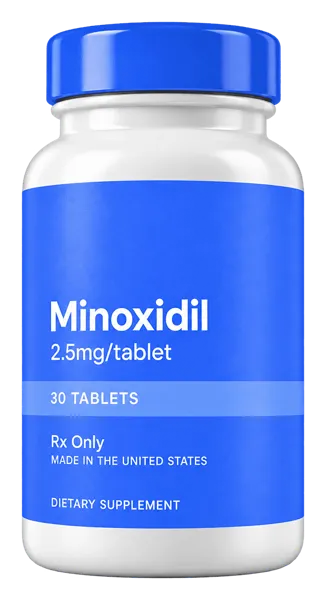
Low cost is a big part of the appeal: a 2026 review lists lower cost among oral minoxidil’s advantages over the topical (Ong et al., 2026), and the 2022 New York Times story that drew attention to it was headlined “An Old Medicine Grows New Hair for Pennies a Day, Doctors Say” (title as cited by Desir et al., Skin Appendage Disord 2024). As one example of a bundled online service, Bodybuilding Peptides listed its minoxidil 2.5 mg oral tablet at a per-month price of $99 on a one-month plan, $89 on a three-month plan, $79 on a six-month plan and $69 on a twelve-month plan, as checked on October 12, 2026; prices change, so check the current listing. The women’s trials above used 0.25 mg to 1 mg a day, and what any tablet means for an individual dose is a prescriber’s decision.
What are women saying about oral minoxidil?
Women who stay on it mostly describe a trade they are willing to make: better hair, some unwanted hair elsewhere. That is the picture from published patient reports, which is what this section draws on rather than a sample of social posts. In the 102-woman survey, reported hair loss severity fell from a median of 7 to 4 on a 10-point scale over a median of 12 months, scores on a women’s hair-loss quality-of-life questionnaire improved from 67 to 39, and most who grew extra hair did not consider it a reason to stop (Sharma et al., 2026).
The wider trend is a story about media as much as medicine. After the August 2022 New York Times article, Google searches for oral minoxidil rose sharply and stayed up, and the authors of that analysis closed by calling for larger clinical trials (Desir et al., 2024). That gap is still the honest takeaway in 2026: demand has run ahead of the women’s evidence, which is promising, small and almost entirely outside menopause-specific research.
Status: Minoxidil: Active ingredient is FDA-approved; compounded versions are not FDA-approved, and use for hair loss is off-label. What these status terms mean.
Sources
Every clinical figure on this page traces to a drug label or the peer-reviewed literature below.
- Ramos PM et al. Minoxidil 1 mg oral versus minoxidil 5% topical solution for the treatment of female-pattern hair loss: a randomized clinical trial. J Am Acad Dermatol 2020
- Vahabi-Amlashi S et al. A randomized clinical trial on therapeutic effects of 0.25 mg oral minoxidil tablets on treatment of female pattern hair loss. Dermatol Ther 2021
- Nascimento e Silva M et al. Randomized clinical trial of low-dose oral minoxidil for the treatment of female pattern hair loss: 0.25 mg versus 1 mg. J Am Acad Dermatol 2022
- Ramos PM et al. Female-pattern hair loss: therapeutic update. An Bras Dermatol 2023
- Vañó-Galván S et al. Safety of low-dose oral minoxidil for hair loss: a multicenter study of 1404 patients. J Am Acad Dermatol 2021
- Sanabria B et al. Adverse effects of low-dose oral minoxidil for androgenetic alopecia in 435 patients. J Am Acad Dermatol 2021
- Sharma et al. Quality of life and patient-reported side effects of low-dose oral minoxidil in treating female pattern hair loss. J Dermatolog Treat 2026
- Dewey et al. Safety and tolerability of combination oral spironolactone and low-dose oral minoxidil for hair loss in adult females: a retrospective cohort study. J Am Acad Dermatol 2026
- Sinclair RD. Female pattern hair loss: a pilot study investigating combination therapy with low-dose oral minoxidil and spironolactone. Int J Dermatol 2018
- Perera E, Sinclair R. Treatment of chronic telogen effluvium with oral minoxidil: a retrospective study. F1000Research 2017
- Sobral et al. Efficacy and safety of oral minoxidil versus topical solution in androgenetic alopecia: a meta-analysis of randomized clinical trials. Int J Dermatol 2025
- Jimenez-Cauhe J et al. Characterization and management of adverse events of low-dose oral minoxidil treatment for alopecia: a narrative review. J Clin Med 2025
- Gupta AK et al. Low-dose oral minoxidil and associated adverse events: analyses of the FDA Adverse Event Reporting System (FAERS) with a focus on pericardial effusions. J Cosmet Dermatol 2025
- Akiska et al. Low-dose oral minoxidil initiation for patients with hair loss: an international modified Delphi consensus statement. JAMA Dermatol 2025
- Ong et al. Oral minoxidil for alopecia treatment: risks, benefits, and recommendations. Am J Clin Dermatol 2026
- Jimenez-Cauhe J et al. Hair follicle sulfotransferase activity and effectiveness of oral minoxidil in androgenetic alopecia. J Cosmet Dermatol 2024
- Kearney et al. Androgenetic alopecia in women: a narrative review of pathophysiology, clinical evaluation, and treatments. Am J Clin Dermatol 2026
- Zouboulis CC et al. Skin, hair and beyond: the impact of menopause. Climacteric 2022
- Anderson et al. The role of hormones in female androgenetic alopecia: focus on menopause. Climacteric 2026
- Desir et al. Increased interest in oral minoxidil for hair loss treatment following publication of August 2022 New York Times article: a Google Trends analysis. Skin Appendage Disord 2024
- Minoxidil tablets prescribing information, DailyMed
- Women’s Rogaine (minoxidil) foam drug facts label, DailyMed
Educational information only, not medical advice. Clinical statements are sourced to FDA drug labels and the peer-reviewed literature linked above. Patient-reported findings describe what study participants said, not proof of effect. Last reviewed October 12, 2026.
Advertising disclosure: links marked "Paid link" go to Bodybuilding Peptides (trybbpeptides.com), an affiliate destination, and The Midlife Protocol may earn a commission if you buy there. Our coverage is independent of that relationship, and nothing on this page is medical or legal advice.
 See it at Bodybuilding Peptides